
The concept "video shopping" speaks to the use of digital video technologies to link customers with e-commerce stores.Customers may see and purchase things during a live, real-time encounter using this conversational commerce system.Yet, there are other sorts of video shopping options accessible.
Some video shopping systems only allow you to chat to consumers in a 'one-to-many' live stream broadcast.Some only enable you to communicate with clients through social media applications.
On-demand video shopping solutions, such as Talkative, allow customers to video chat with customer care agents in a direct, face-to-face connection.This enables a more connected, personal, and convenient virtual buying experience.
What exactly is a ViCom?
Brands may leverage video technology in a number of ways to deliver a personalized and easy video purchasing experience. The most engaging e-commerce stores, for example, will provide a live video shopping experience immediately from their site. This sort of on-demand video engagement, often known as "video chat,"
- Livestream shopping events - in which a virtual store assistant or influencer sells to a large number of consumers via a livestream or 'one-to-many' broadcast.
- Asynchronous video chat entails the exchange of brief video captions between the consumer and the contact agent. Some retail video chat alternatives employ this strategy.
1
Product sales grow as a result of video shopping-
Live video shopping allows firms to sell items with the same level of personalisation that they would provide to customers in-store.
As a result, live video chat may significantly increase sales and average order value.
Fashion firms, for example, may utilize video to showcase clothing goods and answer client questions in real time.
This allows consumers to get a better feel for the product and ask questions that they would not ask through other communication channels such as live chat.
2
Video Commerce encourages-
consumer, brand, and agent interaction. Some Talkative clients had a 400% increase in video chat sessions after implementing video chat on their e-commerce site.
3
Video shopping is a handy and personalized method-
It is critical to provide a great consumer experience.Customers want the best whether you're selling high-end retail items or low-cost things in great demand.
- The good news is that, owing to video shopping applications like Talkative, you can now provide a genuinely personalized digital client experience.
- By conversing with consumers one-on-one, you may learn what they want and need quickly, with unparalleled clarity, rapport, and understanding.
- After all, every other mode of communication is based on written text or spoken speech.Most other video commerce platforms, meanwhile, do not provide an instantaneous, on-demand experience.
- Because video purchasing encounters create a more personal and comfortable online environment for customers, which all customers love.
- Customers are considerably more likely to stay involved when they feel valued, recognised, and heard.
The Takeaway
As we've seen, the greatest video shopping systems have a few characteristics.
These are the video chat settings that allow you to:- Interactions between consumers and support agents that occur on demand.
- Live one-on-one shopping encounters.
- Embeds for both the website and the mobile app.
- Agents for both mobile and desktop assistance.
How Does Our Video Commerce Build Give Live experience?
Videos may assist to establish an emotional connection with viewers and illustrate the characteristics and benefits of a product in a more engaging manner than text or photos alone.
1
Taking charge of the client experience1.
Video commerce enables companies to provide their customers with a more personalized and interesting purchasing experience. Moreover, businesses may use video content to customize how their items are showcased and provide buyers with a more complete look at what they are purchasing. This can assist build trust in the store and the things they sell.
2
Humanizing digital interactions
Video commerce allows brands to add a human element to their online shopping experience. Hence, retailers can connect with customers in real-time and provide a more personal and interactive shopping experience. This results in stronger customer relationships and creates a sense of trust and connection. Even static shoppable videos contain a human element that provides a stronger connection with the consumer on the other end.
3
Data Management
Retailers have more control over first-party data with video commerce since they can collect vital data on how customers engage with their items and purchase behavior. Furthermore, this can help merchants better understand their customers and customize their products and marketing activities to better match their demands.
4
Increased engagement
ViCom enables shops to provide customers with a more engaging and interactive purchasing experience, which may enhance customer engagement and drive sales.
5
Reach a larger audience.
By posting videos across numerous platforms, retailers can interact with customers and reach a larger audience.
6
Personalization
Data on consumer behavior and preferences is gathered using video analytics to build targeted marketing campaigns and personalize the customer experience.
7
Product Presentation
ViCom enables businesses to present things in ways that words and photographs cannot, allowing shoppers to better comprehend a product's features and advantages.
8
Cost-effective
Because it does not require the same expenditures of traditional brick-and-mortar establishments, ViCom may be a cost-effective option for merchants to communicate with customers.
9
Accessibility
ViCom allows merchants to reach out to customers who are unable to physically visit a store, such as those who live in rural areas or have mobility issues.
Artificial intelligence is also becoming increasingly popular in ViCom. AI may be used to customize the consumer experience and make personalized suggestions.
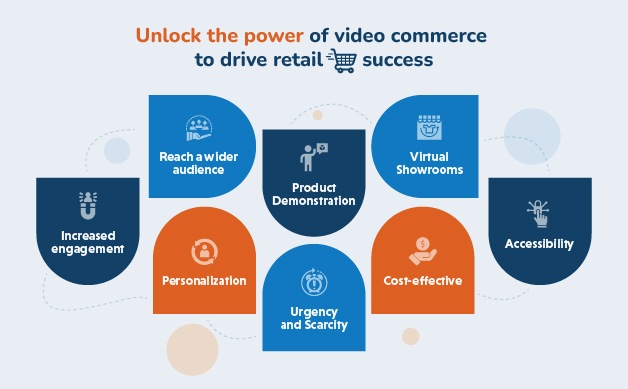
Look at how ViCom can help the retail industry!
Retailers may use Artificial Intelligence (AI) to learn more about their consumers' habits and preferences. With this information, businesses may design customized marketing efforts for certain client segments. AI may also help with inventory management by forecasting demand and changing stock levels accordingly. This assists shops in ensuring that the correct items are in stock at the right moment.
In recent years, the virtual shopping experience has emerged as a critical component of the retail business. With technological advancements, merchants may now provide customers with a more immersive and engaging shopping experience by utilizing virtual reality and augmented reality.
Benefits of ViCom
- Real-time personalized attention
- At-home immersive store-like experience
- Schedule and provide live product demonstrations
- Continuous availability
- One-on-one interactive encounters
- improved product experience
- Increase buyer engagement.
Customers may shop from the comfort of their own homes and discover items in a realistic atmosphere with a virtual shopping experience. Customers may see the product in motion, observe it from various perspectives, and comprehend how it would appear in real life.
Retailers may also employ virtual shopping experiences to create virtual events like fashion shows that customers can attend from anywhere in the globe. The virtual shopping experience has evolved into an effective tool for merchants to attract and keep customers, resulting in higher sales and income.
To remain competitive, retailers must make greater use of video. Videos make buying more enjoyable and reach a wider audience. In addition, video analytics may be used to collect data on customer behavior and preferences and generate customized marketing campaigns.
Physical virtual commerce and the use of technology such as virtual reality, augmented reality, and artificial intelligence in online shopping can improve the user experience and make it simpler to purchase across several platforms.
As technology advances, more shops adopt ViCom and physical methods to remain competitive in today's market.